
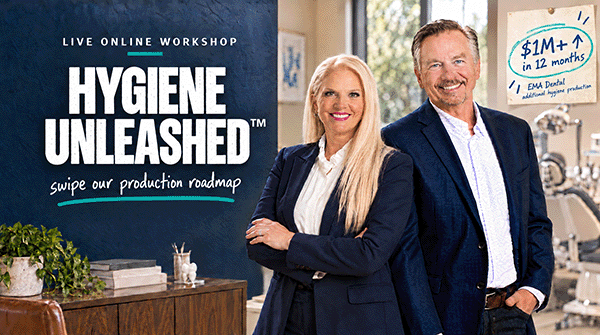
Would you spend $100 to let me show you the hygiene approach that’s transformed more than 3,718 dental practices — and use our Production Roadmap to see where better patient care could unlock production your practice is missing?
For practice owners who want better care and stronger hygiene performance—not more pressure on good people.
Look at what changed at Greenville Family Dentistry. Dr. Matthew McCullough described a practice without a true hygiene and perio program.
Patients heard little about prevention.
Few adult preventive services were offered.
And there was no connected program to carry that care beyond the appointment.
Even a great hygienist needs a clear way to help patients receive that care.
Across the United States, I help dentists and hygiene teams strengthen patient care and production. My work extends to 18 countries, but the starting point is always the same: helping patients understand the care they need.
Greenville brought those pieces together in a true hygiene and perio program.
Hygiene reappointments rose from 65% to close to 98%. Hygienist production went from $90 an hour to $200 an hour or more.
In under a year, the practice reported more than double its production.
What I love about that result is that patients stayed connected to care—and each hygiene hour became more productive.
But you will not see those missed opportunities just by looking at a busy appointment book.
The chairs are occupied.
The wages are paid.
What you cannot see is the patient who never understood the recommendation, the care never discussed, or the next appointment never made.
That is where care—and revenue—can slip away.
Not all at once. In small moments:
a patient hears what is recommended, but not why it matters;
one team member explains the need; another gives a different message;
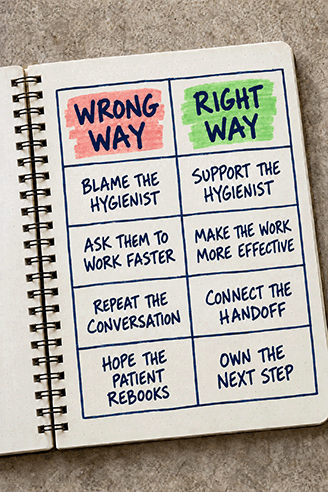
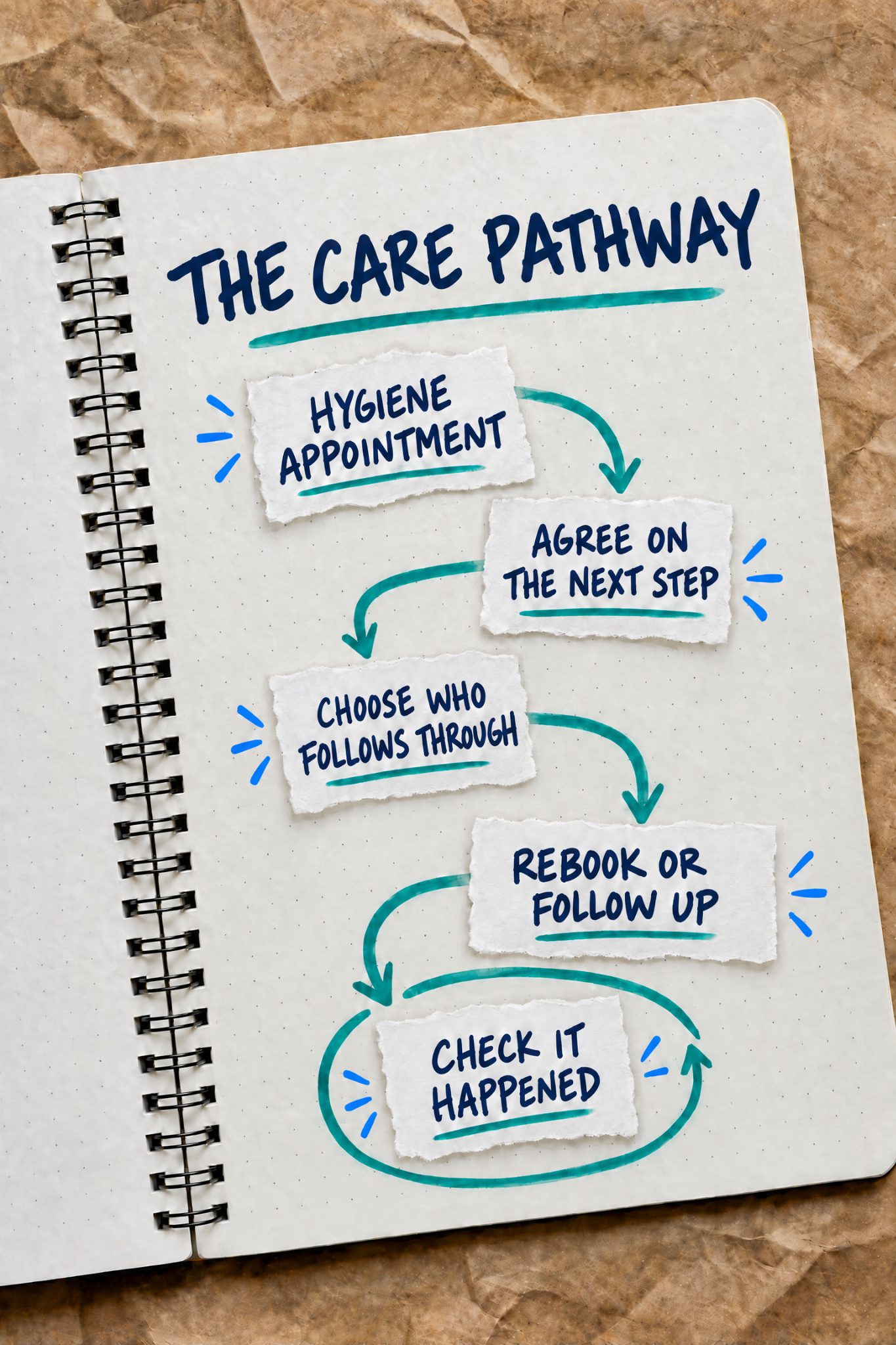
the patient moves from hygiene to the doctor, but the conversation starts over;
no one makes sure the next appointment actually happens;
a capable team keeps working without a clear view of what is being missed;
and the answer becomes “we need more time” before anyone examines how the time is used.
Each one is easy to dismiss in a busy day.
One conversation cut short.
One recommendation lost in the handoff.
One patient who does not come back.
Across a hygiene department, those moments add up—to care patients never receive and production the practice never sees.
And a department can look perfectly busy while it keeps missing that opportunity.
That is what makes EMA Dental’s story worth paying attention to.
Dr. Vincent Mariano thought hygiene was doing fine. When the numbers were examined more closely, there was far more opportunity than he had realized.
After putting our hygiene system in place, EMA Dental unlocked over $1 million in additional hygiene production in 12 months. Its newest hygienist produced $54,000 in a single month.
A busy schedule had not shown him what hygiene could really produce. That’s the opportunity I want to help you see in your own practice.
So when I hear, “How do I get my hygienists to produce more?”
My first question is, “What would help them deliver the care our patients actually need?”
One question adds pressure.
The other gives us something useful to examine.
What is missing from the way the practice supports that care?
Sometimes a patient does not understand the recommendation. Sometimes they understand it, but the next step breaks down between hygiene, the doctor, and the front office.
Those are different problems. They need different changes.
At Southern Smiles of Sylacauga, the challenge was not an empty schedule.
Dr. Rick Redmond was booked three to four months out. The team was stretched, and comprehensive care was difficult to fit in.
Adding more patients was not the answer.
They worked on carrying the hygiene conversation into the doctor’s treatment discussion, so patients could move through care with a clearer, more connected experience.
The practice reported hygiene production up 25% in the first month. Practice revenue rose 55% in the first year.
Better use of the opportunity already there—not simply more people through the door.
That matters when the team is already busy. Before asking them to do more, we need to understand what would make their work more effective.
I know how this feels from the other side of the chair.
Hit the goal.
Offer more care.
Keep on time.
Without a clear way to do all three.
I was that hygienist, hearing that hygiene needed to produce more.
Learning to explain appropriate care changed my approach. For more than 20 years, I’ve helped hygiene teams connect better patient care with stronger production.
And that production needs to work for the whole practice, not just look good on a report.
How much of it does the practice keep?
Bowcutt Dental brings that part of the conversation into focus. Hygiene production had stalled, and Dr. Kevin Bowcutt was struggling to make improvements stick.
They strengthened preventive and periodontal care, made reappointment more consistent, and gave team leaders responsibility for sustaining the change.
The practice went on to increase revenue by 62.5%. Profit more than doubled, while average employee take-home pay increased about 20%.
That is the kind of win I want for a practice: stronger care, a team that shares in the progress, and a business that keeps more of what it produces.
Four practices. Four different gaps.
The common thread is not asking more of the hygienist. It is understanding what better care requires—and what is getting in the way.
That is what I will help you see in Hygiene Unleashed.
I’ll lead the teaching, with Dr. John Meis hosting the session and helping connect the insights to your decisions as an owner.
Then we’ll bring the opportunity into view: what care patients may be missing, what it could mean in production, and where to look first.
First, I’ll show you how the three hygiene roles, the appointment, and the team around it work together to support stronger care and a more profitable department.
We call this part: SEE THE SYSTEM.
Then we’ll use our Production Roadmap and focused questions to put the opportunity into perspective—and identify what may be holding it back in your practice.
We call this part: LOCATE THE CONSTRAINT.
Put them together, and that is Hygiene Unleashed.
A clearer picture of the care your department could support.
A financial view of what may be getting missed.
And one priority to examine—not another long list to hand your hygienists.
Here’s how we’ll do it:
First, we’ll SEE THE SYSTEM.
I’ll walk you through The Hygiene Growth Model: how more complete patient care, effective delivery, and a sustainable business contribution connect around your existing team.
1. More Complete Patient Care
Preventive therapist. Periodontal therapist. Patient treatment advocate. You’ll see what each role contributes—and why a patient attending an appointment is not the same as understanding and receiving the appropriate care they need.
(The opportunity starts with better care—not a bigger target.)
2. More Effective Hygiene Delivery
We’ll follow the patient’s conversation through the appointment and into the next step. Where does understanding carry forward? Where does the team have to start again? Better support can make the work more effective without asking people to rush.
3. A More Profitable Department
More production needs to contribute to the practice—not just look impressive on a report. We’ll connect care and effectiveness to the financial picture, so you can see why production, collected revenue, and profit are different questions.
4. The Team Support Behind All Three
These three parts work together when your team has clear care standards, patient understanding, connected handoffs, and people who know their role. You’ll see where good clinicians can be held back by a system that asks too much of one person.
Now the numbers have a context. You can start asking what is missing—not simply who needs to produce more.
Some of these pieces may already work well.
Your hygienists may be excellent.
The question is whether the practice gives them the support to deliver that level of care consistently.
Then, we’ll LOCATE THE CONSTRAINT.
I’ll guide you through our Production Roadmap, with John helping you connect the care opportunity to your decisions as an owner.
This is where “there may be more potential in hygiene” becomes a more useful business question.
We’ll work through a prepared example together: preventive care, periodontal care, and the restorative opportunity that hygiene can help patients understand and move toward.
Which care category shows the potential gap?
What could that difference represent in production?
Are patients understanding the recommendation?
Is the next step clear—and does it happen?
Or are time, capacity, and team responsibilities getting in the way?
Then we’ll bring it back to your practice.
If you have reliable numbers, use them to frame your own preliminary opportunity. If you don’t, you’ll still identify the area worth examining and the information you need to check. No spreadsheet scramble while I’m teaching.
A number gives us a reason to look closer.
The questions help us decide where.
You’re not leaving with a department to rebuild on your own. You’re leaving with a likely gap, a clearer understanding of what it could mean, and the first thing to investigate before choosing a fix.
The care opportunity visible. The financial stakes clearer. A focused place to start.

You’ll apply what I show you throughout the session, with John and me there to guide your thinking as you work.
You will not simply listen to what another practice did.
You’ll have identified where hygiene may be getting held back, seen how the Roadmap sizes potential production opportunity, and chosen what to examine first—with your own preliminary figures where usable data allows, or a clear question to take back to your numbers.
Logistics
This is a live, interactive working session where you’ll apply the model to what’s happening in your own practice—with us guiding the questions.
Not a collection of hygiene tips.
Not another lecture to pass on to your team.
You don’t need a completed calculator to take part. Bring an honest picture of how hygiene works in your practice.
We’ll work through the Roadmap on screen together. If you have reliable hygiene figures, keep them nearby. If you don’t, you can still follow the example, recognize where to look, and note what needs checking.
If you do not have the numbers, you are still welcome.
Not knowing yet gives us a useful place to begin—not a reason to sit this out.
Date: Monday, November 16, 2026
Los Angeles: 5:00 PM Pacific
Dallas / Chicago: 7:00 PM Central
New York: 8:00 PM Eastern
Length: 90 minutes
Presenters: Wendy Briggs — Teaching Expert; Dr. John Meis — Host
Can’t make it live? You’ll receive the complete recording and the confirmed workshop resources by email afterward. But applying the model to your own practice, answering the questions, and choosing where to look first is the reason to join us live.
Your Investment:
$100 USD
Here's What We'll Cover
The Bonuses:
I want you to be able to focus while we’re together. We’ll send the resources afterward, so you’re not trying to do both. That leaves us free to focus on your practice and where to start.
A private one-to-one strategy session where a senior TTI advisor runs the Production Roadmap live with your own numbers. You’ll leave knowing the size of your hygiene opportunity, what may be holding it back, and the first thing to check.
The exact words your hygienist uses to hand a patient to the doctor, so the conversation picks up where hygiene left off instead of starting over. It feels natural to patients, not salesy.
A monthly scorecard that follows one patient from first call to next appointment and puts a number on every step. It shows where patients and production slip through, so your team can fix one thing at a time.
A two-minute daily tracker for each hygienist that records fluoride, sealants and other preventive care, and calculates the production for you. See fluoride acceptance against an 80% target, and watch preventive care grow month by month.
Watch and rewatch any time. We’ll email your replay and toolkit after the live session so you can stay focused while Dr. John and Wendy are teaching.
This Workshop Is Not for Every Practice Owner
Don't come if...

This is for owners who want hygiene to be a stronger partner in patient care and practice growth.
Owners ready to see where appropriate care, patient understanding, follow-through, capacity, or team support may be limiting the opportunity already in their practice.
You do not need perfect numbers.
You do need an open mind about what your team could do with the right support.
Because more pressure is not the same as a better system.
Your hygienists can be more than the people who keep the schedule moving.
They can be partners in helping patients understand and receive better care.
Let’s look at what would make that possible in your practice.
Better care for patients. A supported team. Stronger production and profit. Let’s make the opportunity—and where to start—clearer.

President & Co-Founder, The Team Training Institute
Wendy Briggs, RDH, is a practicing hygienist, trainer, coach, and author, and President and Co-Founder of The Team Training Institute. Her track record includes helping U.S. practices improve patient care and double hygiene production. In Hygiene Unleashed, she brings that clinical and training experience into an owner-level working session—helping you see the opportunity and where to focus first.

Host & Co-Founder, The Team Training Institute
Dr. John Meis hosts Hygiene Unleashed and brings the practice-owner perspective to Wendy’s teaching. He helps owners connect the model to their own decisions, then leads the closing conversation about moving from insight to implementation. Together, John and Wendy connect the clinical and business sides of growth—because recognizing an opportunity is different from aligning the people and support to act on it.